Managers Club
All questionsCollected Wisdom

What's your advice for managers who are just starting out?

58 engineering leaders answered this question. Their responses, alphabetically.

Alexandra Paredes

Head of Engineering at Code Climate

As a new manager, you will be faced with a variety of new situations, challenges are often vague and is up to you to bring clarity and definition so your team can succeed, the way you behave and communicate matters and sets the tone for the team, and there are so many other little things that change as you transition into the role. It can feel overwhelming and that’s completely normal.


Read the full answer
Andrew Mairena

MBA student at MIT Sloan School of Management (and formerly Application Engineering Manager at Thermo Fisher Scientific)

My advice is to have structured, routine one-on-one meetings with everyone on the team. There are various opinions on how often it’s supposed to be done, but my personal recommendation is to hold a 30 min session every week. Each session has three components. In the first ten minutes, the person talks and leads the discussion. In the second ten minutes, I review current initiatives and next steps within the week. The third important piece is what I call “outwards looking”, like personal and professional career planning.

Read the full answer
Anne Hjortshoj

Manager, UX Research and Strategy, Cisco Cloud Security

When people start to manage teams, it can be difficult to escape the feeling that you’re failing in some way, all the time, because—unlike working as an individual contributor—your work is never done. You will always be failing in some way. Learn to prioritize. Your job is to unblock and enable your people, and to listen closely for issues that you may have to manage indirectly. Also: get very comfortable with delegating! And be humble, because the minute you think you have it all figured out, you’ll be presented with a situation that challenges you.

Read the full interview
Anthony Mazzarella

Director, Core Engineering at BAMTECH Media

Embrace the reboot. All that knowledge of distributed systems, Linux, programming languages, and systems availability gained over the last n years? Well, I have some bad news: None of it is going to help you get through your first 90 days as a manager. Fret not, though. There is some good news! This can and should be, exciting.

Read the full answer
Anurag Maunder

SVP of Engineering at Kindred.ai

Management is a full-time job – one that is not done well when you revert to acting as an individual contributor for solving problems.

A former boss of mine used to say that “either you are a good communicator or you report to one.” I’ve kept this in mind throughout my career and think it encompasses a lot of the characteristics that every great manager embodies. Team communication requires a certain amount of self-awareness, a quality that sheds light on your personal strengths and weakness and allows you to learn from them.

Read the full answer
Bella Kazwell

Web Engineering Lead at Asana

Invest time in building a relationship with your reports. I will admit, the first few 1:1s can feel awkward or like a waste of time – maybe there’s nothing that feels pressing to discuss. However, those first few 1:1s can be some of the most important time you’ll spend with your reports because it’s an opportunity to lay the groundwork of a healthy and productive manager/mentor relationship. In my first 1:1 with a new report, I like to ask what works for them, what they’ve liked and didn’t like and how I can be a resource for them.

Read the full answer
Benjamin Encz

Director of Engineering at PlanGrid

Blanket advice is hard. But I have two pieces that should apply pretty widely.

Firstly, one of the biggest differences in switching from engineering to engineering management is that you no longer have clear tasks and deliverables. Your goal is to improve the performance of your team, but it is mostly up to you to identify what you need to do in order to accomplish that. You need to make time to inspect how your team is working, identify areas for improvement and devise tasks from that.

Read the full answer
Brent Baisley

VP of Engineering at Ticket Evolution

Leadership has been studied and analyzed for decades. Approach it the same way you would a new skill, technology, or programming language. Read up on the theories, philosophies, and studies from Tuckman, Hersey-Blanchard, Maslow, Herzberg, Brandon Hall, Sinek, Dweck, Covey, Chamine. Read Google’s Project Aristotle and Project Oxygen. Google’s conclusions were largely theorized by all the others before them, they just backed it up with real data. This will increase your leadership potential and put you on the right trajectory. Be aware that this only gives you the knowledge on how to be a great leader. Actually being able to perform as a…

Read the full answer
Chaitanya Atreya

Director of Engineering at Teradata

As aspiring managers and leaders, one needs to balance a lot of competing priorities and sometimes even competing principles at work. You end up spending enormous amounts of energy doing these balancing acts. However, know that each leader has a set of identities, the invariants, the legacy. These are the things you are known for. These are the things that when all else fails, you would still stand for. Make sure you identify at some point early on in the managerial journey what these are, and live every day and every decision by these invariants.

Read the full answer
Chuck Groom

Director of Engineering at VTS

Spend your first two weeks doing nothing; watch and listen. Resist the urge to jump in and fix things. Learn that things tend to work even without you.

The worst thing a new manager can do is manage. You can’t ever really manage creative people; you can give them goals, you can inspire them, but you can’t demand creativity happen right this moment.

Read the full answer
Daniel Dvorkin

Director of Engineering at Modern Tribe

I have 3 tips that took me a while to accept for myself but have been pretty useful:

Stop coding and pay real attention to your team. Don’t skip 1:1s and remember that your new job is all about building trust.

Even if you think you’re good at delegating, pay attention. Chances are you’re “fake delegating” where you hide enough context from the team that they still need you. Learn to delegate for real.

Read the full answer
Debjani Sarkar

Director of Engineering at Nuance Communications

I truly believe in leading and motivating people and not managing. People can manage their tasks and time well if they have clarity of goals and responsibilities. As leaders, our job is to provide that clarity and enable them for success. My mantra has been to engage, enable and empower folks and success will follow.

Read the full interview
Denali Lumma

Director, Software Development at Box

I think companies don’t have a good solution to solving the problem. There are roles, like TLM (technical lead manager), that were created at Google and propagated through the industry. I prefer the term “apprentice manager,” but essentially, it’s this idea of someone who has grown into a tech lead, who clearly has a domain expertise, and who has shown and demonstrated leadership capabilities and leadership success. It’s about helping them to bridge the gap into people management, without formally making the transition immediately.

Read the full answer
Elena Tatarchenko

Backend Engineering Manager at DataFox

Listen to your direct reports. That’s the most powerful thing you can do. You’re now one of the few access points your team has to upper management and other parts of the org, so you absolutely have to make sure their voice carries through you. You won’t know what that is unless you listen.

Be a team player. Your team’s success is not more important than the company’s success. Be willing to shift resources. The benefit here is also that your direct reports will get to work on the high impact projects and probably go out of their comfort zone and learn a lot.

Read the full interview
Erin Kidwell

Build, CI & DevInsights Manager at Netflix

Aim for growth, not perfection. Set clear and measurable objectives that also add business value. This doesn’t necessarily mean KPI’s, metric or estimates. It can be as simple some of the following examples:

Read the full answer
Eugene Bochkarev

VP of Engineering at Xero

Yeah, Vidal, this is actually a great question. I really like it because I think a really big part of being a manager is helping other managers to grow. This is a big part of our job. The question is pretty generic of course. Right? On a different part of your career, you give different advice. For different people, it would be different advice. Somebody needs to be more technical. Some people need to be less technical. Some people need to be more involved in the processes. Some people need to spend more time with people. It’s so different.


Read the full answer
Federico Soria

Engineering Manager at Airbnb

I actually go back and forth between management and individual contributor. The only thing is I never stopped coding, I just now code for fun in my free time as opposed to get paid for it. But my number one advice is that think of it… So I think two things. One it’s a different job. Don’t think because you have managers you know what it is. You probably seen people fix your plumbing. That doesn’t mean that you’re good plumber. So it is a different role. It is a different job, and it’s fine to start from scratch, and you’re going to learn it and this totally fine, but you should treat it as such. Not like oh I know I’ve had millions of…

Read the full answer
Gady Pitaru

Chief Technology Officer for Badger Maps

Hire people who are smarter than you and reliable. As your team grows, you’ll need to be able to trust those around you to come up with solutions to problems and execute on those. Have regularly scheduled, open and honest one-on-ones with everyone on your team. It naturally makes you a better manager when you are helping your employees grow. Find the tools that work with how you naturally manage your work, ideas, tasks, and team and lean on them heavily to make your life easier. Trust your intuition, the things that scare you or make you nervous are the things you should handle first, and build the team you would want to work with.

Read the full interview
Gergely Németh

Engineering Manager at Uber

First, make sure you pick management for the “right reasons”, and also the “right flavor” of engineering management. Do you find joy in helping others succeed? How much coding will be required/possible in your new position, and are you okay with that? And the list goes on – but in short, prepare for a career which is dominated by people problems, not technical problems.

Read the full answer
Hampton Catlin

Sr Director of Engineering, Rent the Runway

Focus on how you can get to the results. I don’t mean KPI’s or numeric results… though if you are passionate about those, then go for it. I mean, the final product. Your job as a manager is to manage people who need to build and maintain great stuff. Part of it is making sure your employees are happy! Part of it is making sure their career goals are clear! But, all that is in service of just producing great work.

Read the full answer
Isabel Nyo

Engineering Manager, Technologist, Writer, Speaker, Mother

Everyone has to start somewhere. Don’t be disheartened if you feel like you are not being a good manager. You can always learn to become better at anything if you have the will. And if you think you are a good manager, then that’s good but guess what, you can become an even better manager. I wrote about how I survived and thrived as an engineering leader to encourage and teach new engineering managers so feel free to take a look at it. My one advice, or rather my one belief, is that to be a good leader, you need to be a servant leader.

Read the full interview
Jeba Singh Emmanuel

Engineering Manager at Linkedin

Different companies have different expectations from managers. A five-person team in a startup has very different needs from a larger team in a startup vs. a smaller team in a larger company. As a manager, you are responsible for understanding what is needed. Try to get very clear expectations. If possible, look for opportunities to help your manager with some management responsibilities to become familiar with what a manager does. LinkedIn has a program called the Apprentice Manager Program, which was really helpful for me when I started out. It had coaching sessions, training materials, and a lot of other helpful classes. LinkedIn also has…

Read the full interview
Jerry Li

Senior Director at Groupon

When starting out as a manager, I think the biggest challenge is to know what you don’t know. Since you’ve not been in management before, and you’ve probably not had any training or education either, it is important to know what new mindsets and skills you need to have in order to do a good job as a manager.

Read the full answer
John Van Heteren the

Director of Treatment Delivery Applied Research at Varian Medical Systems

I recommend that new engineering managers join manager networking groups. Examples of such groups in the San Francisco Bay Area include:

Silicon Valley Engineering Leadership Community (SVELC) San Francisco Engineering Leadership Community (SFELC) IEEE Technology and Engineering Management Society (IEEE-TEMS)

Read the full answer
Kate Wardin

Senior Engineering Manager at Target

Don’t try to fit into the perfect mold of a manager – be yourself. Identify, make yourself aware of, and work to improve your gaps, but spend more time working to invest in your strengths.

Read as much as you can – there are so many leaders in our industry who graciously share their stories and wisdom.

Read the full answer
Kimber Lockhart

CTO at One Medical

One of the most confusing parts of getting promoted into management is figuring out what exactly you’re supposed to do. It can be easy to revert back to what made you successful as an individual contributor–getting through projects, solving problems and shipping code. Instead, take the higher level view and ask, “What would it take to make my team successful? What are the goals we’re going after and how can we target those goals in a way that makes sure we’re going to hit them?” Success becomes less about what you do as an individual and more about what your team can accomplish. Your performance is now that of your team.

Read the full answer
Lavanya Ramani

Software Development Manager at Amazon

That’s again a very good question. One of the pieces of advice that I’ll give to the new managers is taking life easy and take your career easy as it is not a linear journey. This is something that I learned as well. But when I thought it’s very easy. Oh, I’ll become a manager in two years. I’ll become a Senior Engineering Manager. Then in two years, I can become a Director in two years, I can become a Senior Director in two years then I can become a VP followed by an SVP. I become a C-Suite, no,

Read the full answer
Lei Yang

VP of Engineering at Quora

I recently discussed this during a talk I gave called “What I’ve learned taking over engineering teams of different sizes” on July 18 at SFELC. You can check out the video below.

https://youtu.be/Jpv0y45l0\M

Video can't be loaded because JavaScript is disabled: What I’ve learned taking over engineering teams of different sizes with Lei Yang, VPE @ Quora (https://youtu.be/Jpv0y45l0\M)

Read the full answer
Lena Reinhard

Director of Engineering CircleCI

Understand your position. – I find it very important to understand and acknowledge the power that comes with formal leadership roles. Explicit and implicit power comes in different shapes, and in addition to role-specific power, other factors like tenure, specific expertise, gender, or other factors can add to it. Especially when moving from peer to manager, it’s important to understand how the impact of your words and actions changes, and how your behaviour, as well as what you encourage or discourage in others’ actions, contributes to normalising certain behaviours and building culture.

Read the full answer
Libor Michalek

President, Technology at Affirm, Inc.

Well, I’m always a little hesitant to give advice without context of who’s receiving it and what they’re taking away. Because it is very contextual. And context is extremely important in terms of not just giving advice, but also taking advice.

Read the full answer
Lior Gavish

Senior Vice President at Barracuda Networks

Sometimes it will align with your own personal interests. Sometimes it will be a detriment to your own personal interests. But I think in the long-term it pays out and it’s something that people appreciate and that will make you a better leader over time and will make you more successful. And so it’s really important to remember that you’re there to serve the customers and make everyone more successful, not just yourself or just your team. The other thing I will give as advice is, and this is advice that I got as a young leader and I really carry this and it was really helpful for me, someone explained to me, you don’t motivate a team, you…

Read the full answer
Margaret Schmitt

Senior Director of SBU Solutions Enablement at ANSYS

Stay humble – one of the things I have learned is the ability to say – “you are right,” to your team, when they have an idea that’s better than your own. Being able to listen and learn from what your reports are telling you is critical in making the right decisions and leading your team. Also, I am a huge supporter of building bench strength, and I truly believe that your success is dependent on your ability to create a strong bench behind you. If you try to play it safe by being indispensable, then you are not scaling and not preparing yourself to move on and leave a strong intact team behind you. Remember you as a leader have the…

Read the full interview
Matt Newkirk

Engineering Manager at Etsy

Risk over-communicating with your reports on everything: why you’re trying to change a process, why you’re asking for something, what impact they’ve had. Talk to your peers about how they’re tackling different problems, and find a mentor within your company or outside of it.

Empower your reports to solve their problems; you don’t have time to be an action bottleneck for your team.

You have a new job, and you need feedback to guide you. Set the early expectation that you welcome feedback from your reports and reward them by listening when they give it to you.

Read the full interview
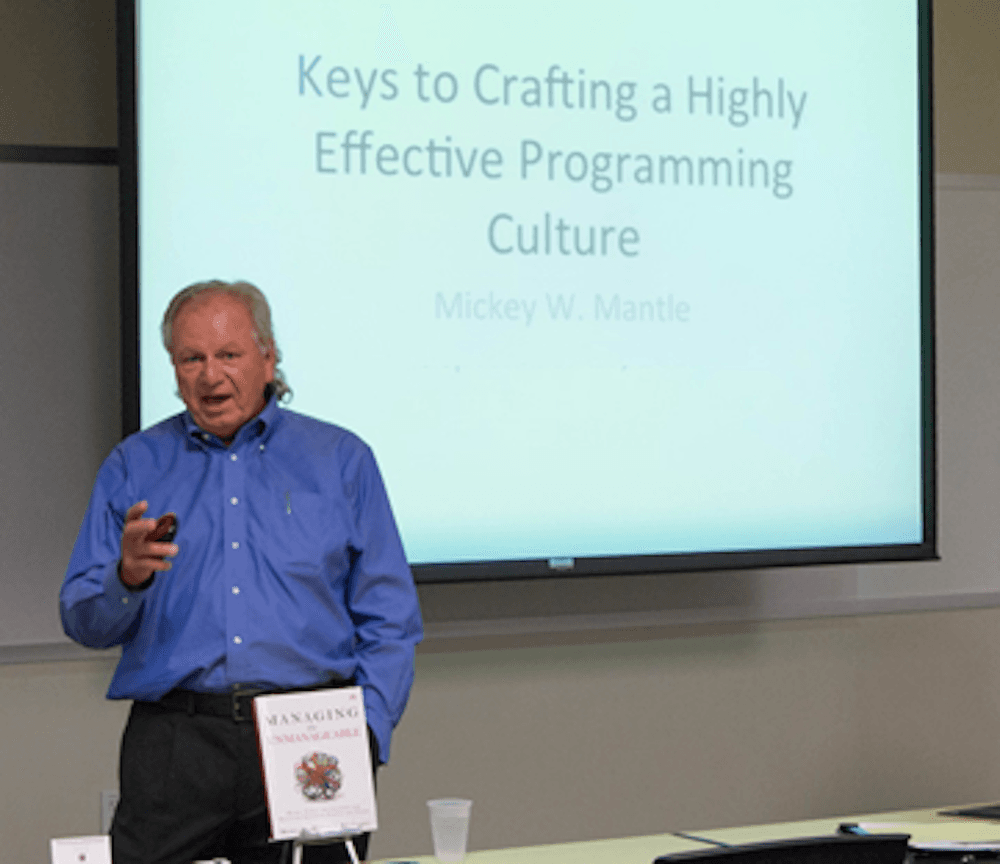
Mickey Mantle

Co-author:  Managing the Unmanageable and Founder/CEO Wanderful interactive storybooks

My primary advice would be to learn from others who’ve already taken the hard knocks. That’s primarily what drove Ron and I to write the book we wrote. We wrote the book we wished we’d had when we first started out managing programmers. And based upon the comments in a number of the 5 star reviews we’ve received on Amazon, the information we have provided has hit home with many readers who have benefited from our experience.

Read the full answer
Nat Fast

VP Software Development at Viscira

Be humble. You work for your team, they do not work for you. It is your job to make them successful within the organization, the team and in their personal life. You are the servant leader. Your position is not one of glory, let your team have that. Think of yourself as Jeeves from PG Wodehouse plus a smidge of Admiral Rickover.

Admiral Rickover said,

Read the full answer
Natasha Vinnik

Senior Engineering Manager at Google

One thing I’ve learned from my experience and also from helping others to grow into management role is that being a tech lead and being a manager are not the same. Those two roles look deceivingly similar, but they are not and switching from one to the other is challenging. When becoming a manager, it is no longer about you making the right technical decisions it is about you guiding your team to make decisions. Your role is now about supporting the team versus your individual contribution. If you end up making a decision and the team didn’t feel like they owned it, they will tend to rely on you to make other decisions too and it becomes…

Read the full answer
Oliver Plattner

VP of Engineering at Codecademy

Make mistakes and embrace them: We are all imperfect but what is most important is our ability to learn from our mistakes and grow as individuals.

Be transparent: I share my own performance reviews and culture surveys with my entire engineering team. It helps to know what we are all working towards to help one another succeed.

Build trust: Set your team up for success and create a supportive work environment. Your team will feel empowered to become self-starters and ask each other for help.

Read the full interview
Patrick Joyce

Director of Engineering at Stitch Fix

Three big things:

1. Managing people is a completely different job than writing software. 2. Your first responsibility is the health of your team. 3. Manage yourself. The feedback cycle as a manager is much longer and less clear than when you’re writing software, but the payoff can be huge.

I have two more tactical bits of advice I like to share.

Read the full answer
Pei-Chin Wang

Senior Director of Product at Redfin

Do you have any advice for new managers, people who are just starting out as managers? A lot of people who listen are new to management.

Read the full answer
Poorani Jeyasekar

Delivery Lead for Celerity Consulting

My advice is, when you start out, the first 30 days start with your team and understand your team. What are their strengths, what are their opportunities, and what is the mission and focus of your team? What have they accomplished, what do they have to deliver, when do they have to deliver, who do they hand off the deliverables to and how do you care and feed your team?

The second 30 days, go to your leadership. Understand what does your leadership want out of your team, and why do they want it and how do they want it? And the third thirty days talk to all the external people that are interacting with your team and touching with your team.

Read the full answer
Randy Raw

VP of Information Security at Veterans United Home Loans

I think it would be to recognize that you are now on a new learning path and a new learning journey, especially when we’re in information security and an IT/technical position. You’re going to have to learn a lot of what we’ve referred to often as soft skills and all of the things that are not technical. There’s a lady named Whitney Johnson that talks about an S curve and I really believe that that she’s onto something. With our technical people, we need to figure out how to recognize that as you’re on an S curve, it’s hard at the beginning and then you hit a sweet spot in the middle. You can’t stay in that sweet spot forever. You have to…

Read the full answer
Raylene Yung

Head of Payments at Stripe

Don’t rush to become a “people manager” too quickly, especially if it comes at the cost of deeply understanding the work and daily technical problems your teammates are facing. I find that the best new managers are able to build off a solid technical base, and can jump in to help with technical issues when the team really needs it. Also, unfortunately, you can’t really rush through learning the people side of things. Some lessons and skills can only really hit home after you have experienced them first-hand, such as performance management.

Read the full interview
Raymond Lai Co-Founder

CTO of Mitterra Ecommerce Solutions and Author of This is Professional Services

Do you want to be a manager or a coach? A manager is fixated on metrics and ensuring the team completes their tasks and processes to reach those metrics. A coach defines a goal, and inspires the team to reach that goal.

And a caveat: I’m in no way an expert, but here’s my advice:

Read the full answer
Rich Archbold

Senior Director of Engineering at Intercom

My advice is get some really good mentors/coaches. Go out of your way to curate your own network. Find people who you admire, reach out to them to meet for a coffee. Share your current problems and strategies with them and seek advice. Do your best to get an old head on young shoulders. Read books. Take every training opportunity that comes your way. Develop your sense of self awareness, your sense of knowledge and your sense of empathy. My favourite book is “Radical Candor” (Kim Scott) followed by “Crucial Conversations” (Al Switzler, Joseph Grenny, and Ron McMillan). These books helped me develop my own awareness and sense of empathy.

Read the full interview
Robby Russell

VP Engineering, Partner at Planet Argon, LLC

Even your smartest and most autonomous employees have a deeply rooted desire to be led. If I had a chance to go back and offer myself advice 13 years ago, it would be something along the lines of, “Hey, Robby! Yes, listen a ton… and delegate outcomes to the team… not tasks.”

Read the full interview
Ron Lichty

Consultant, Interim VP Engineering and Author

We wrote a whole article on that topic a year ago that Better Software magazine made its spring 2017 issue’s cover story – “Do You Really Want to be a Manager?”

There’s a lot of richness in the article, so let me just share two broad strokes…

Read the full answer
Saminda Wijegunawardena

VP, Engineering @ Box

There’s are two misassumptions that I overcome with mentoring new managers.

One is that people like me just always knew this stuff and I’m like, “No.” A lot of things I preach is because I made a lot of mistakes early on. When I first became a manager and was drafted into it. I really didn’t know what I was doing and I didn’t have any management training. It was so long ago, there were no blogs or posts or any of these kinds of like the stuff that you’re doing that really enable people from a community standpoint. It was a pretty isolated experience. I learned by wanting to improve and through more and more experience.

Read the full answer
Sanjay Zope

Director of Software Engineering, NationalMI

Management is not a god gifted talent but a skill that can be learned. Learning is the key to getting better at management skill. It depends on the individual’s learning approaches. I learned it the best possible way by doing an MBA where I took courses on negotiations, effective communication, corporate finance & management in organizations. It helped me learn the toolbox and approaches to managing situations as well as people more effectively.

Another great way to improve the skill is through practice and observing great managers.

Read the full interview
Shilpi Sanchetee

Engineering Manager at Slack

Be patient. As a manager, it can be hard to know when you are doing all the right things and are delivering an impact to your team and the company.

People first. Don’t rush into action and understand your team’s needs. Don’t apply one way of management to all your reports – change per each individual’s style.

Find your tribe. Your first team is your EM peers – build trust, invest time and help each other grow.

Read the full interview
Sol Rosenbaum

Director, Green & Energy Services at GRS Group

It is important to understand the difference in skill sets between being an engineer and an engineering manager. Being a good technical engineer does not automatically imply that one will be a good engineering manager. In order to become a good engineering manager, you will have to learn new skills to be efficient with the business and oversight of the project in general. You will need to understand how to motivate your team and to understand all of the various components (not just technical) that need to come together for a successful project.

Read the full interview
Swaroop C H

Engineering Manager at Helpshift

The biggest obstacle to being a good manager, in my limited experience, is changing the mindset. It’s no longer about me or what I can do – it’s all about what the team can do! My project is no longer writing code – my project is building an effective team. I can no longer can get quick wins – I have to wait for wins by the team. It’s no longer about deep work just for me – it’s about enabling deep work for my teammates, which means shielding distractions, ensuring a good sequence of projects, etc. And so on.

Read the full interview
Varsha Dudani

Engineering Manager at DoorDash

A big part of managing is ownership. I’d advise new managers to adjust their perspective so that no work is too big or too small for them to lend a helping hand. Those who are willing to pick up anything that comes their way are generally the most supportive (and successful) managers. This also includes seizing opportunities as they arise and giving it your best. Show the initiative and work hard to deliver a great outcome – let the work speak for itself.

Read the full answer
Vishal Saxena

VP Global SaaS Operations at Aktana

I’ll set up three things that they need to look for, right. Learn to listen. When they have one-on-one or when they are talking to them give them undivided attention. That is one thing, thank and empower them. Let them make the decisions, manage the results, not manage the task. Otherwise, you are falling into the trap of micromanagement. And a very important thing that I think has to be open for critiques. I’m not perfect and it gives me an opportunity to grow and learn from my team and from others. So those are the three things. Learn to listen and empower the team and don’t micromanage and be open for critique.

Read the full interview
Xing Chen

Senior Director, Software Engineering at Thumbtack

Be authentic and be yourself. It’s important to learn from good mentors and do your homework on management basics, but ultimately you have to just do it your own way. Recognize that there are a lot of different ways to be a great engineering leader and execute the eng manager role. People also spike in different ways in terms of what they are great at. There’s no formula and so part of learning to be a manager is just to go through the cycles and try it yourself (hopefully with a good mentor around who can guardrail you a bit).

Read the full answer
Yagiz Erkan

VP of Technology at Motive Retail

This is a hard one to fit in a few short paragraphs. My last blog post (https://medium.com/@yagiz/14-ways-to-become-a-better-technical-manager-leader-7b57324c2a6d) deals with this point in greater detail, but I’ll try to summarize some of its points. You don’t only need to be a good manager, but a good leader too. They are related, but not the same thing. Always have a beginner’s mind. Acknowledge that you have a lot to learn, and never stop learning. Use different mediums: read books and articles. Discuss with your peers online or face-to-face. Watch or attend talks and go to meetups. Try to find a mentor or a coach. Put your team before…

Read the full interview