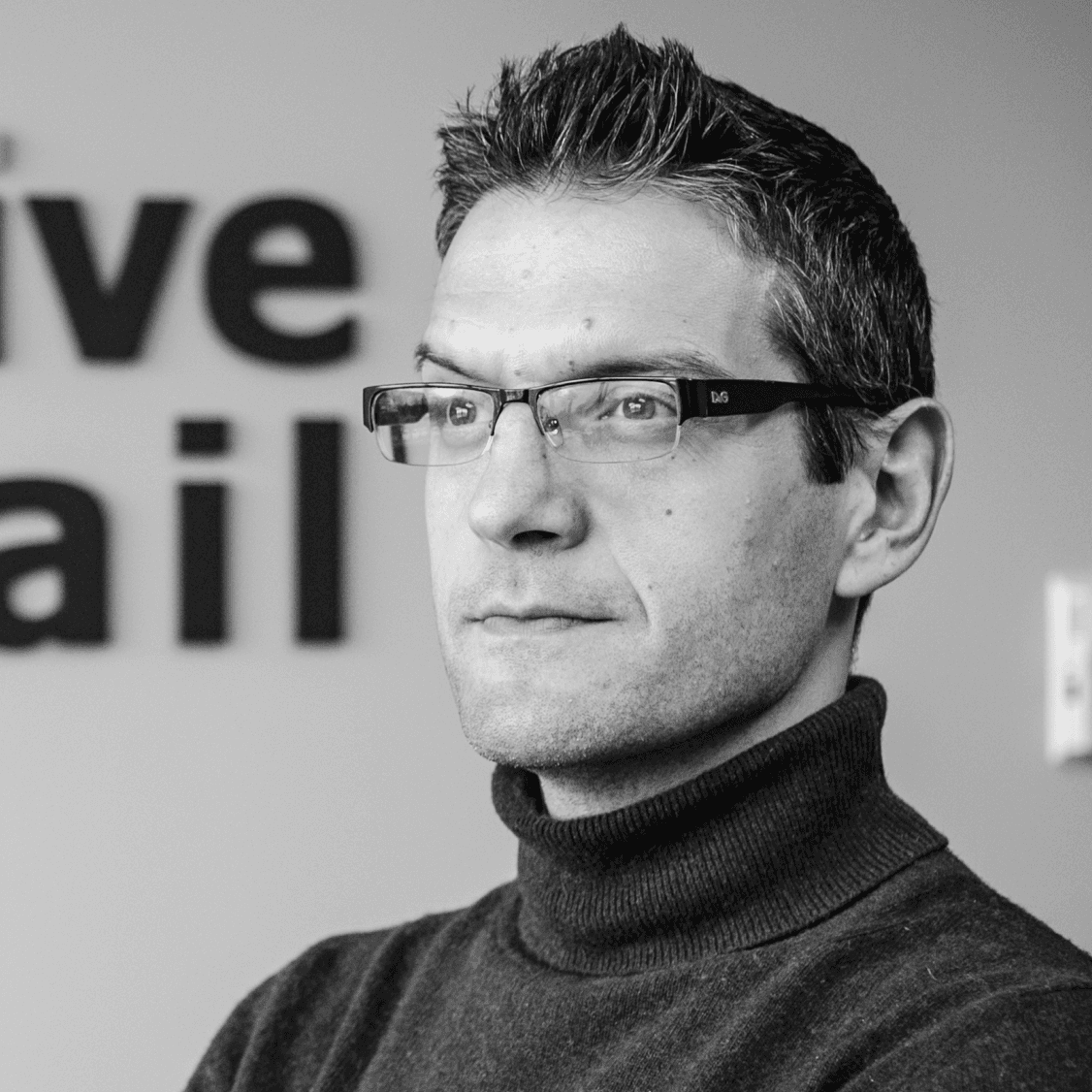
Interview with Yagiz Erkan, VP of Technology at Motive Retail
By Vidal Graupera · · 6 min read

Location: Boulder, CO
Current Role: VP of Technology at Motive Retail
What’s your background and how did you get into management?
I went to college in France in the early 90s, in the beautiful city of Lyon. I studied computer science and management. In those years, I witnessed the Internet’s leaving the academic realm and its discovery by businesses and the greater public.
The Web was fascinating. I learned everything I could about it. Thanks to that skill set, I secured a great internship position at a local startup during my master’s degree. That same startup offered me my first job. I developed a Web client for our technical document management system. After that good start and thanks to my continuous learning efforts, I remained “the new technology guy” in the following years.
My first management experience came with a project management position in Ireland. I still remember how conflicted I was. I loved technology, and above all I loved to design and create, but I had never undertaken management and leadership responsibilities officially. My professional curiosity got the better of me, and I seized the opportunity.
It was a disappointment. I felt the job wasn’t technical and hands-on enough. Bear in mind that this was nearly 20 years ago. Looking back, I can see how young and inexperienced I was. After a year of mixed emotions, I decided to pursue my career as a Technical Architect, a role that comprised of hands-on technology and technical leadership. 5 years later, under the Chief Technical Architect title, I got back into management. Soon after I was leading a team of 9 architects, some of whom had their own direct reports.
I’ve been good at building happy and productive teams. I’ve also loved leadership challenges as much as technical ones. Successfully facing those challenges brought me where I currently am. And the journey continues.
What are the biggest challenges you face?
At a personal level this question is part of my ritual. Every 6 months or so, I ask myself a couple questions. This gives me an appreciation of how I have evolved. For instance, 10 years ago I would have told you my personal challenge was “patience”. Today, my challenge is finding the suitable ways to develop the managerial effectiveness of some of my people.
Another current challenge of mine is to strike the right balance in the number of our remote and local software developers. Not surprisingly I have to deal with competing priorities and many variables.
In product development, one of the biggest challenges has always been doing the right thing. I work closely with the product managers/owners in defining a product vision that not only answers our current users’ needs, but also anticipates the needs of our future users. I also ponder the questions of what technology best serves our vision and how best to utilize it for our business needs.
What is your approach to hiring?
My wife used to be an HR Manager experienced in recruitment, and she was great at it. So I’ve had a good mentor, and I’m still learning loads from her.
One important part of hiring happens before I even see the first résumé: reviewing the reasons that trigger the recruitment, deciding whether recruiting externally or internally, and writing the job description from our expectations as opposed to starting from a title and developing the description for that title.
Once the opening is advertised, I shortlist résumés, I prescreen candidates over the phone first, before inviting some of them to a face-to-face interview. I now know that if the team is involved in hiring as opposed to putting this responsibility solely on a hiring manager, the new member is more compatible and the team is more productive.
I hire for potential and approach to work. I value hunger for learning and self-development. If I hire you for your current skills only, you’ll do the job this year, but I’d like to know how much you’re willing to grow alongside your team and the company.
What’s your advice for managers who are just starting out?
This is a hard one to fit in a few short paragraphs. My last blog post (Medium) deals with this point in greater detail, but I’ll try to summarize some of its points. You don’t only need to be a good manager, but a good leader too. They are related, but not the same thing. Always have a beginner’s mind. Acknowledge that you have a lot to learn, and never stop learning. Use different mediums: read books and articles. Discuss with your peers online or face-to-face. Watch or attend talks and go to meetups. Try to find a mentor or a coach. Put your team before yourself. Be humble and serve, but don’t be intimidated by own your authority. You have the power to make certain things happen. Don’t command, but persuade. And be a good listener and communicator. Be open and transparent. When you say no, explain your reasoning. Ensure that your team trusts you enough to give you candid feedback. Be ready to admit that you’re wrong or that you don’t have the best idea. Don’t be afraid to look vulnerable.
What’s your workday like and how do you manage your time, emails, etc.?
My morning productivity has significantly increased since my move to the US. Before going to bed I make a list of things that I need to achieve the following day. I wake up to this list, mentally ready for the day’s known challenges. I usually listen to TED talks or audiobooks during my short commute to work.
I’m in the office at around 7 AM. I take a peek at my e-mails, Slack and JIRA to decide whether anything needs immediate attention. I meet with the product team and the dev team early. I eyeball the previous day’s Git activity, and usually take some time to walk through certain parts of the new code. I do my best to schedule the beginning and the end of my day as a manager, and the middle (10ish to 2ish) as a maker, as I still do some amount of creative or focused hands-on work.
Never using my professional e-mail address for personal reasons help me eliminate much of the e-mail noise. I check my e-mails at different times of the day of my choosing. But I’m always a-tap-on-the-shoulder away from my people when they need my help.
What’s a personal habit that contributes to your success?
So, we’re talking about habits, and not skills. Hmm… It’s hard to limit this to a single one, so please forgive my picking three:
The first one is learning. I allocate time for learning activities outside of work hours. This usually materializes as reading articles or books, listening to talks, watching presentations and online training sessions, attending meetups or MOOCs. I’m a lifelong learner.
The second one is constantly looking for ways to be more productive. In personal and professional life alike, I look for ways to increase productivity in tasks and processes, and I question assumptions. I’m always curious about how people do what they do, and I try to learn from their way of working. I also believe on spending money on things that make me more productive.
My third one is keeping fit and healthy. Eating healthy, regularly exercising and having enough sleep help immensely in one’s ability to be at the top of one’s game.
Share an internet resource or tool that you can’t live without.
If I have to pick a single one, it has to be Pocket (getpocket.com). Having a “read-it-later” list keeps me sane. It allows me to prioritize my reading, and also bookmark sites that I want to check later. Here’s how I use it: I have Pocket installed as a Chrome extension and it comes bundled with Firefox. I have it as an application on my iPad and my iPhone. During the day, if I come across an interesting article, video or a website, I add it to my Pocket list. After work, when it’s time to read, I go through my daily list, I create a quick mental priority map, and I choose the article that tops it. This is my way to dedicate my time only to the most important articles of the day, knowing that I have a book requiring most of that time allocated to reading.
If you could recommend one book to managers, what would it be and why?
There are many great management and leadership books, and it’s not easy to pick a single one. I quite like the novelized format of some of these books, and the first one that pops to my mind is Patrick Lencioni’s The Five Dysfunctions of a Team. It is an easy read. Its messages are very important but are easy to grasp.
Where can we go to learn more about you? (LinkedIn, Twitter, GitHub, etc.)
I write on Medium: Medium
I’m on LinkedIn: LinkedIn
I’m also on twitter: @yagiz – Twitter